
Re: A news item and subject which I just want to check out (188) February 20, 2026
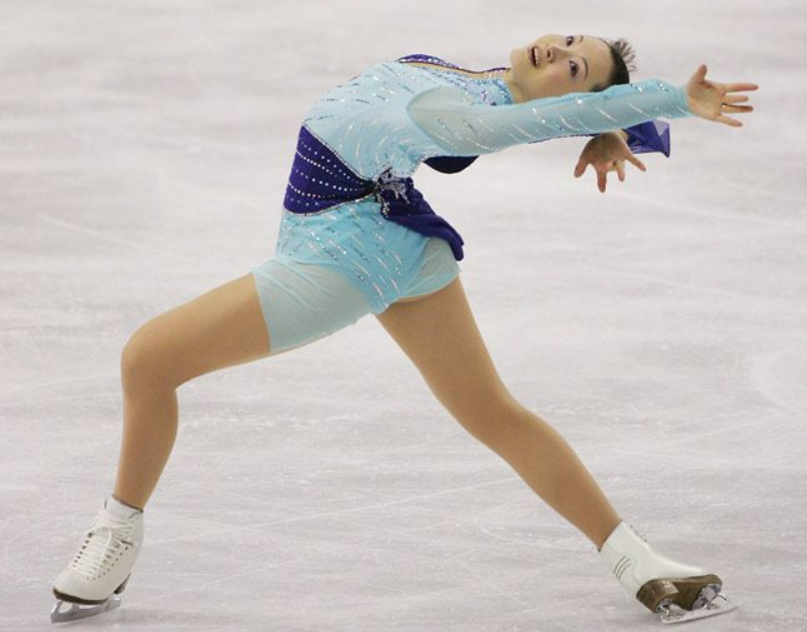
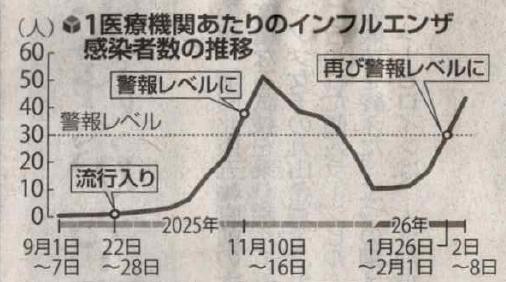
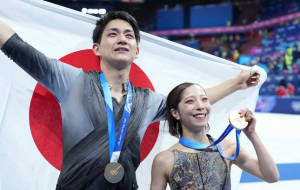
The 2026 Milan-Cortina Olympics, held over 17 days from February 6 to 22, are now entering the final stages. About 92 to 93 countries and regions are participating in this Olympics, with about 3,500 athletes completing fiercely in 16 sports and 116 events. The athletes compete only once every four years create numerous memorable moments, and this is truly something only seen at the Olympics. What was particularly moving was the pair figure skating free program on February 16, where the Riku Miura-Ryuichi Kihara pair delivered an incredible performance full of intensity that brought them the gold medal. Watching it was exciting and thrilling, and my eyes were glued to it. I felt relieved when it finally ended safely. In addition, what still strongly sticks in my memory from the Winter Olympics is the breathtaking Ina Bauer performance by Shizuka Arakawa in the women’s singles figure skating at the Turin Olympics 20 years ago, where she won Japan’s first gold medal. At that time, I had just undergone heart surgery due to a virus, and I fondly remember being amazed by that incredible skill I saw during my rehabilitation. By the way, since the beginning of the year, influenza has regained momentum, and following last autumn, it has reached an unusual situation considered to be at an “alert level”. There are said to be cases where children and young people can become seriously ill. We should both be careful.
■■What I have recently thought and focused on:
■The Liberal Democratic Party won a landslide victory in the House of Representatives election:
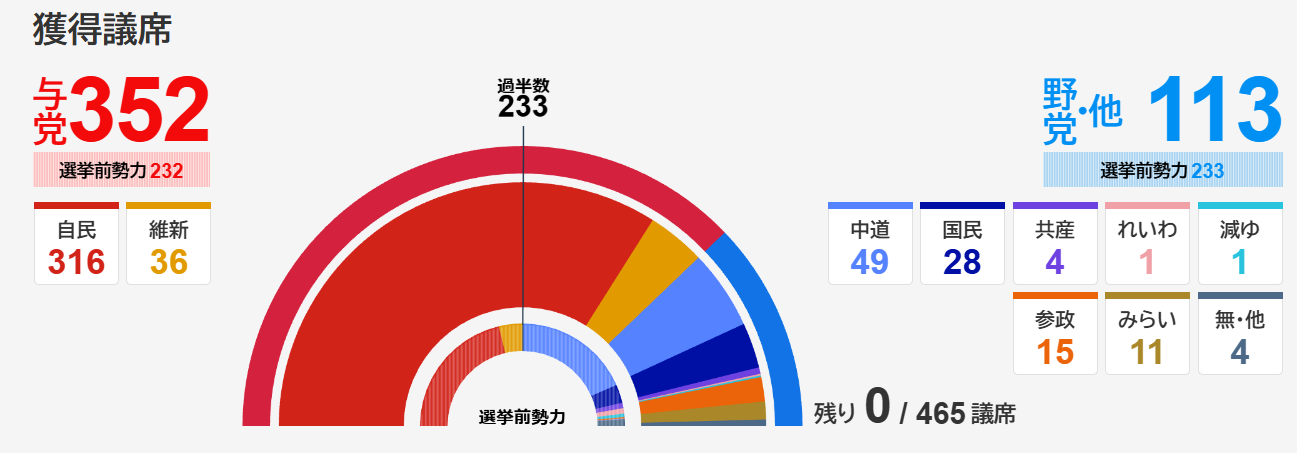
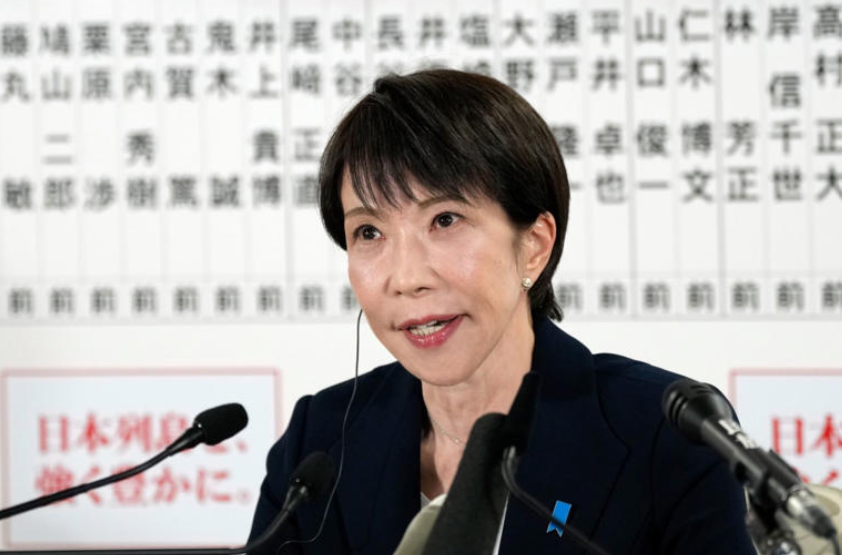
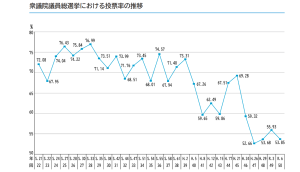
The noisy House of Representatives election came to an end on February 8. This election was the shortest election campaign in history, lasting only 16 days from the dissolution to the vote, and it ended with a historical landslide victory for the Liberal Democratic Party. The outcome this time was the result of Prime Minister Takaichi’s “all-or-nothing” strategy. Of course, it was not gambling. I think it was the winning intuition that she “could win now”. As I mentioned in the previous issue, she proudly considers herself a beloved disciple of the late Prime Minister Abe, and as such, she seems to have both “courage” and “shrewdness”. This is an important quality for a politician.
And in addition to the newsworthiness that she is “the first female prime minister in our country’s constitutional history”, she repeated “Work!” five times, prominently projecting the image of a person who “works through the night for the nation and the people”, and asked the people to put their trust on her. Of course, she has a view of the nation and a view of economy based on strong beliefs. But in this election campaign, she kept those things under wraps, and put “emotions”, what people nowadays call “emo”, front and center. On the other hand, as for the opposition, “the Centrist Reform Alliance” formed by the Constitutional Democratic Party and the Komeito failed to gain public support, and other small multiparty groups were also in a disorganized mess maneuvered by party interest. As a result, the opposition effectively handed a landslide victory not so much to the Liberal Democratic Party as to Ms. Takaichi.
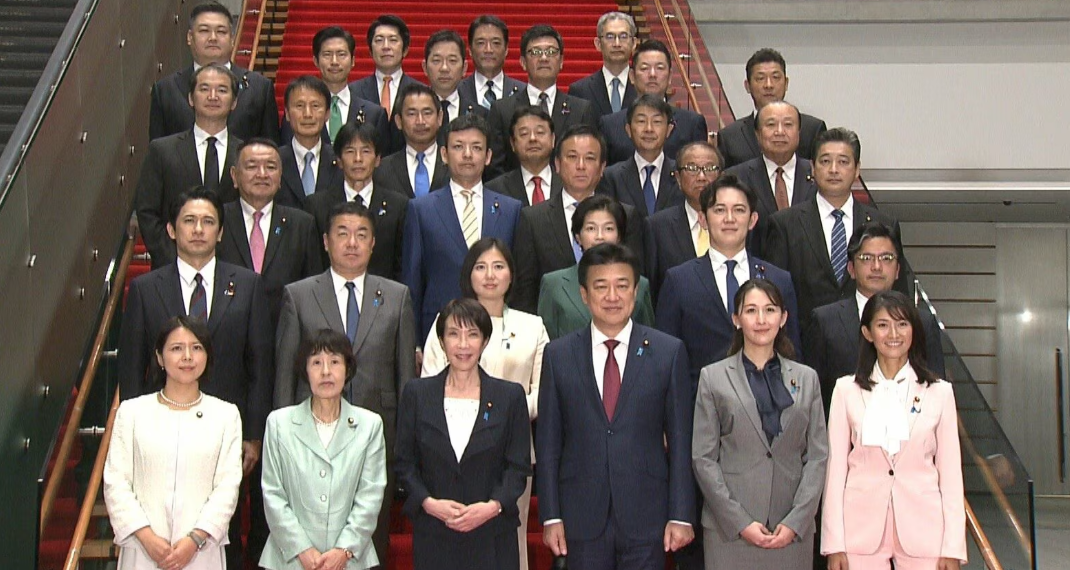
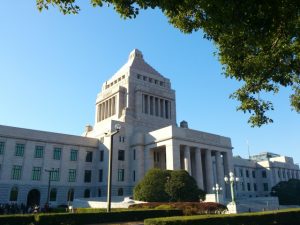
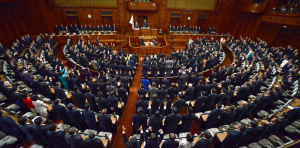
And the special Diet session was convened on February 18, and the second Takaichi Cabinet was inaugurated (the session will last 150 days, until July 7). The focus of economic policy is “responsible proactive fiscal spending” and “the sources of funding for tax cuts”. In a Diet where, in practice, everything from budget to bill deliberations is under the control of the Liberal Democratic Party, can we really expect tense debates between the ruling and opposition parties? In the end, the ultimate evaluation of Prime Minister Takaichi will be reflected in “market” trends (interest rates, the yen exchange rate, and stock prices).
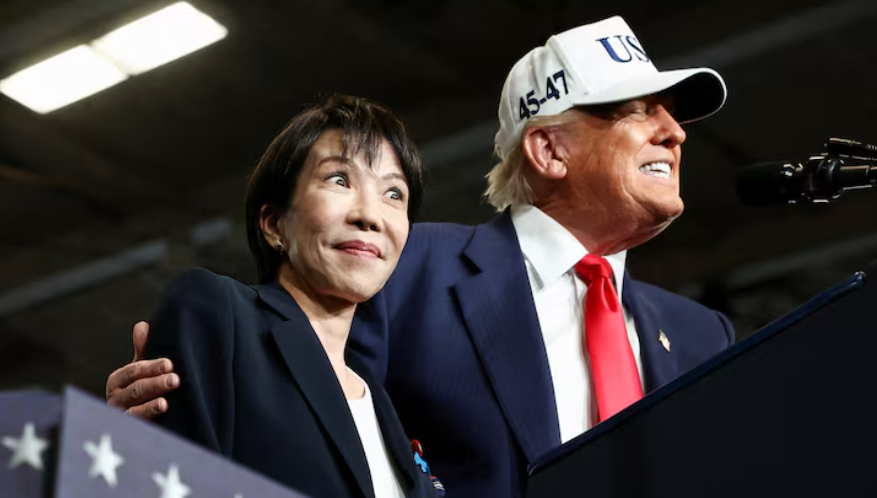
By the way, Prime Minister Takaichi is scheduled to visit the United States in late March to hold a summit meeting with President Trump. When dealing with a tyrant or dictator like him, it is important to see if she has good chemistry with him. In this regard, the late Prime Minister Abe was skillful.
On the other hand, President Trump will visit China in the first week of April, and recently, he has shifted his policy toward China from “confrontation” to “cooperation”. However, China takes an unyielding stance on Taiwan as a “core interest”. And European countries are seeking to reduce their dependance on the United States by moving closer to China, and the leaders of each country are visiting China one after another. China’s aim is to divide Japan and the United States, as well as Europe and the United States. The same is true for emerging countries such as the Global South, which are also moving closer to China. Even in Taiwan, which is in the midst of turmoil, the largest opposition party, the Chinese Nationalist Party, held an exchange meeting with the Chinese Communist Party in Beijing this month for the first time in nine years. Under such circumstances, Japan is only one “left out”. While geopolitical risks are increasing, there is no intermediary between Japan and China, and amid being despised as “pro-China” or “China-friendly”, it is a test of Prime Minister Takaichi’s skill to see how she can break through the current situation. If she does not overcome this, “diplomacy that takes a panoramic perspective of the world map” will not be possible.
■The Spring Festival has started:
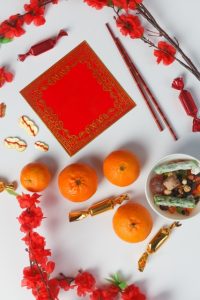
This year’s Spring Festival (Lunar New Year) falls on February 17, and in China, it is a long holiday period of nine days from February 15 to 23 (one day longer than the previous year). Other countries with large Chinese populations (such as Singapore, Malaysia, Indonesia, and Philippines), as well as South Korea, also celebrate the Lunar New Year. (South Korea’s statutory holidays are from February 16 to 18, but including Saturday and Sunday, it effectively becomes a five-day holiday.) During this period, economic activity almost comes to a halt. This year, in addition to Seoul, South Korea, popular overseas travel destinations for Chinese people seem to be major Southeast Asia cities such as Bangkok, Thailand, and Singapore. Japan is out of the rankings this year.
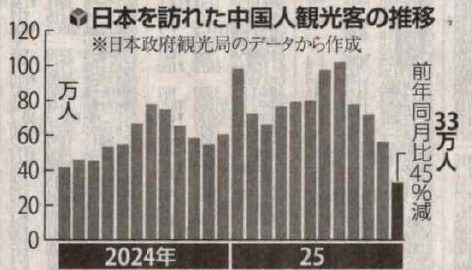
In addition, the estimated number of Chinese visitors to Japan in 2025 was 9.09 million, making the second highest after South Korea. This year, due to the cooling of Japan-China relations, the Chinese government has called for people to refrain from traveling to Japan, and group travelers from China have dropped to zero (individual travelers are an exception). For your information, looking at last December alone, the nationwide total was about 0.33 million, a 45% decrease compared to the same month the previous year. Even within Osaka prefecture, the year-on-year comparison for the same month still fell by 45% to 0.176 million. Reflecting these trends, flights from China to Kansai International Airport during the Spring Festival period are expected to decrease by more than 40% compared to the previous year.
■Japan’s GDP (Gross Domestic Product):
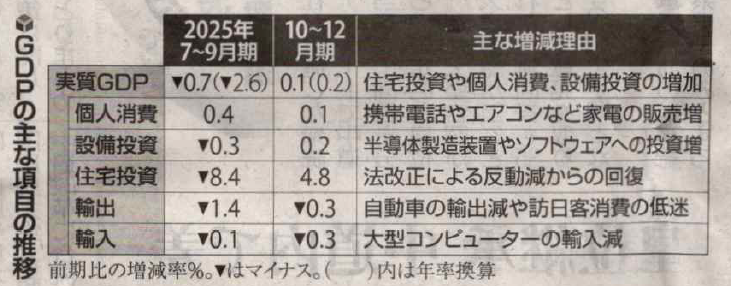
The preliminary figures for real GDP from October to December last year showed a 0.1% increase from the previous quarter (an annualized increase of 0.2%), making positive growth for the first time in two quarters, but it fell far short of the private sector’s forecast of a 1.7% increase. And personal consumption, which accounts for more than half of GDP, grew by only 0.1% quarter-on-quarter, showing a lack of strength due to high prices. Exports fell 0.3% from the previous quarter due to a decline in automobiles.
As a result, the nominal GDP for the calendar year 2025 was 662.8 trillion yen, an increase of 4.5% from the previous year, but real GDP, adjusted for price increases, rose by only 1.1%.
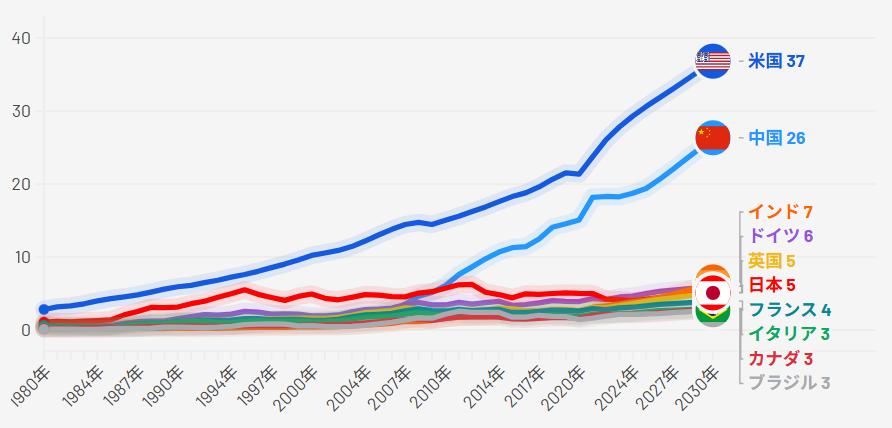
On the other hand, Japan’s GDP has stagnated since the collapse of the bubble in the early 1990s, a period often referred to as the “lost 30 years”. According to the statistics released by the IMF last autumn, Japan surrendered the position of second in the world in GDP after the United States to China in 2010 and became third, and by 2023 it was overtaken by Germany and fell to fourth place. Furthermore, this year, it fell to fifth place in the world, overtaken by India, and it is predicted that it will also be overtaken by the United Kingdom by 2030. And even in terms of GDP per capita, it ranked 14th in the world in 2010, but by 2025 it has fallen to around 40th.
Like this, from a global perspective, Japan’s economic power has clearly weakened over the past 30 years. And the problem is that combined debts of the central and local governments have increased by nearly 800~900 trillion yen, and are now reaching to 1,300~1,400 trillion yen, the worst level in the world. Factors included increased social security costs due to aging and countermeasures against major natural disasters.
On the other hand, the financial assets held by households have increased by about 1,000 trillion yen over the past 30 years, approaching 2,300 trillion yen. From one perspective, it can be interpreted that the government spending that was injected is being stored away by households (and businesses), and is not contributing to strengthening of the foundations of the Japanese economy.
I think that from now on, we should focus not on temporary handouts as economic measures, but on bold deregulation, the development of human resources (education) for creative technological innovation, promotion of digitalization, structural reforms focusing on the restructuring and elimination of small and medium-sized enterprises and improving profitability, upskilling and increasing workforce mobility through reskilling.